Why We Built Catylst
Why We Built Catylst
I want to tell you the story behind this product, because the story is the reason for most of the decisions we made.
A few years ago I sat across from a donor who had just written the largest check of her life. She was a thoughtful person — a veterinarian, two grown children, a pattern of giving that stretched back twenty years. She had moved money into a donor-advised fund that year, and she had a conviction about where it should go. The check had been written. A month later she asked me a simple question.
"What happened to it?"
She didn't know. Not because the organization she supported was hiding anything — it wasn't — but because the apparatus between her intention and the outcome was opaque. She had made the decision. Someone else at her DAF custodian had processed the grant. The recipient had deposited it. A program had continued. And the line connecting her conviction to that outcome was, from her vantage point, dark.
That conversation stayed with me. I had spent my career in financial technology, and I had seen what happens when the infrastructure between a decision and its execution becomes legible. Stock trades used to take days to settle through a chain of manual confirmations; now a retail investor can see the whole chain in real time. Payroll used to take weeks to reconcile; now employees can audit their own deductions. Transparency, done well, doesn't replace trust — it reinforces it.
Philanthropy hadn't gotten that treatment. Not for donors. Not at the scale where it matters most.
The underserved category nobody was calling out
The first thing we noticed when we started looking seriously was that faith-aligned giving is a quietly enormous category. Billions of dollars move each year through donor-advised funds held by donors whose giving is shaped by their convictions — convictions about stewardship, about the nature of a well-spent life, about the communities they belong to. These donors are not a niche. They are, in aggregate, one of the largest pools of intentional capital in the country.
And yet most of the matching infrastructure they rely on treats their beliefs as a filter. A dropdown. A checkbox. A clumsy overlay on a generic discovery flow. When a donor shares that her convictions matter to how she gives, she is handed a tool that behaves as if her convictions are the last thing it should know about her.
We thought that was backwards. We thought a platform that starts with conviction — not as a filter but as a first-class input — could do a better job of surfacing ministries and organizations that actually fit. And we thought a platform that did that could also serve every other kind of donor, because the same discipline of explicit, transparent matching is valuable whether you care about theology or about watershed restoration.
The decision to never touch the money
Very early in the design process we decided that Catylst would not custody funds. Ever. That was not a feature decision. It was an ethical one.
Custody is a specialized, regulated function, and the platforms that do it well have spent decades building the operational and compliance muscle that custody requires. The community foundations and commercial DAF custodians that hold donor assets have bank-level controls around movement of money, reporting, and tax compliance. Those are real specializations, and they deserve respect.
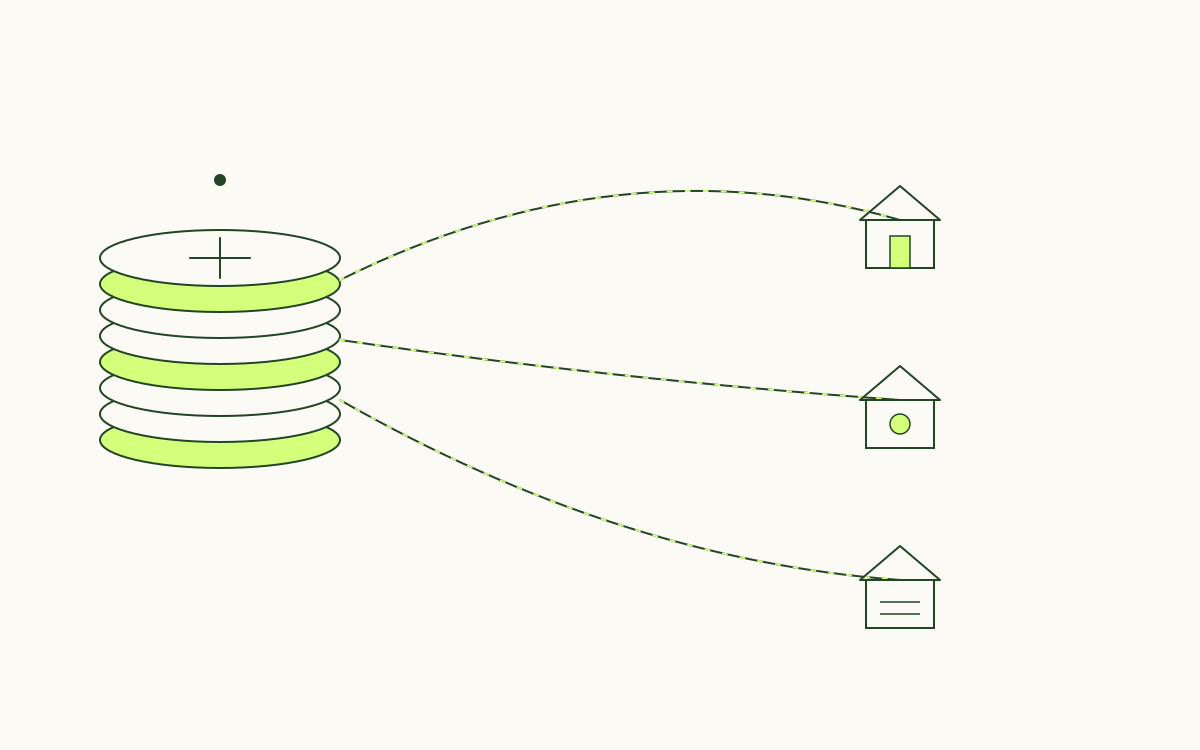
Our job is different. Our job is to help a donor prepare a recommendation that is cited, defensible, and aligned with her convictions — and then to hand that recommendation to her DAF custodian, who executes the grant on their own rails. We prepare. They custody. She authorizes. That division of labor keeps each party honest about what they do well.
The practical consequence is that Catylst is compatible with any DAF custodian a donor already uses. We do not ask her to move her money. We do not ask her to trust us with assets. We ask her to trust us with a piece of preparation work — a cited recommendation that her custodian and her advisor can both audit — and that is a much smaller, much more humane ask.
Cited reasoning, or we don't ship it
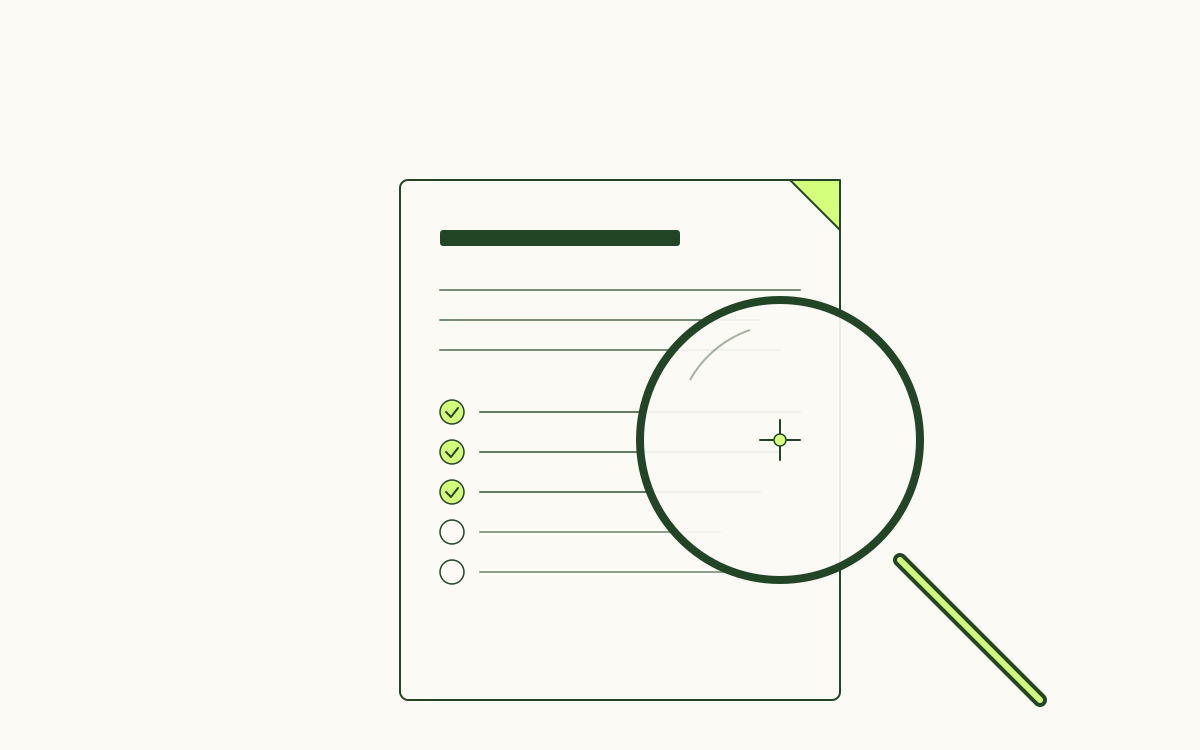
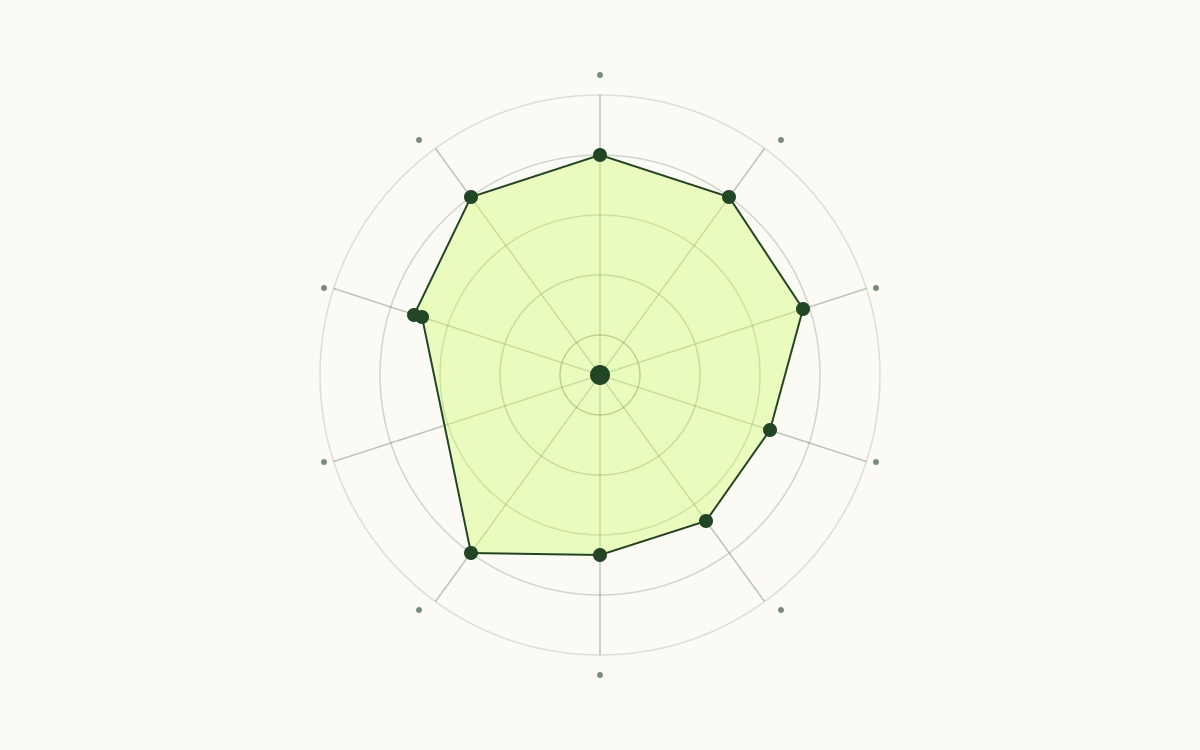
The second decision we made was that every recommendation would show its work. If a ministry appears as a strong match for a donor, the donor should be able to see which fields on her profile and which fields on the ministry's profile produced that match, and she should be able to inspect the confidence we have in each claim. No composite scores. No "87% match" with no explanation behind it. No paid placement, ever.
That commitment cost us some convenience. It is easier to ship a single number than to ship ten transparent dimensions. It is easier to synthesize a confidence interval than to mark the spots where data is missing. But the donor is the one making the decision, and she deserves the evidence. If we blur the evidence to make the interface simpler, we are quietly taking a piece of her agency.
So we chose the harder path. Every match shows its dimensions. Every AI-generated paragraph cites the source material it was drawn from. Every ministry profile flags its own data gaps. If the confidence is low, we say so. If we don't know something, we say we don't know.
This posture extends to the AI we use for summary and drafting. Five checks run on every model output before it reaches a donor: a pass to remove advisory-style phrasing that could be mistaken for financial advice, a pass to verify the drafted claims against the source material, a pass to ensure every citation resolves, a pass for sensitivity around faith context, and a calibration pass on stated confidence. None of these are marketing dressing. They are the guardrails that let us put generative content in front of a donor without quietly putting words in our mouth that we didn't mean.
Dignity — the word we kept returning to
The last decision I want to name is the one that shaped most of the smaller choices. When we interviewed donors — dozens of them, across traditions and demographics — the word that came up again and again was not "efficient" or "transparent" or "powerful." It was "dignified."
Donors wanted a process that treated their convictions as real. They did not want to be flattened into a persona. They did not want their faith fields to carry a penalty in the match quality if they chose not to share them. They did not want a platform that ranked traditions against each other, or that treated one denomination's posture as a default and others as exceptions.
So we built a system where every faith field is optional, and leaving any of them blank does not degrade the match. We built a catalog that recognizes Protestant, Catholic, Orthodox, non-denominational, and interdenominational ministries without privileging any of them. We built a copy stance where "prefer not to specify" is always the first option, not the last. And we built an audit posture around the faith fields that treats them as the sensitive personal information they are — not as metadata to sell to partners.
Dignity isn't a feature. It's a design constraint. Every time we tried to add a shortcut that would have compromised it — a persuasion pattern, a dark nudge, a default that assumed too much — we removed the shortcut instead. The product we ship today is smaller and slower than a version we could have built without that constraint. We think that's the right tradeoff.
An invitation
If you're a donor who has been writing checks into the dark, or moving capital through a DAF that works but doesn't quite see you, I'd like you to try Catylst. You can start with what matters to you — the causes, the conviction, the ministries you already know — and we'll show you organizations that share it. Every match will cite its reasoning. Every recommendation will be something you can hand to your custodian and your advisor without an interpreter in the middle.
If you're an advisor, a foundation, a church, or a ministry, there are doors for you as well. Read more about the organization and the team, or reach out directly if you'd like to explore how the platform fits your work.
We built Catylst because we believe that intention deserves infrastructure, that conviction deserves to be treated as more than a filter, and that a donor should always be able to answer the question my friend asked me years ago: what happened to it?
Ready to see how it works? Start for free and walk through a guided match in about ten minutes. No card required. No money moved.